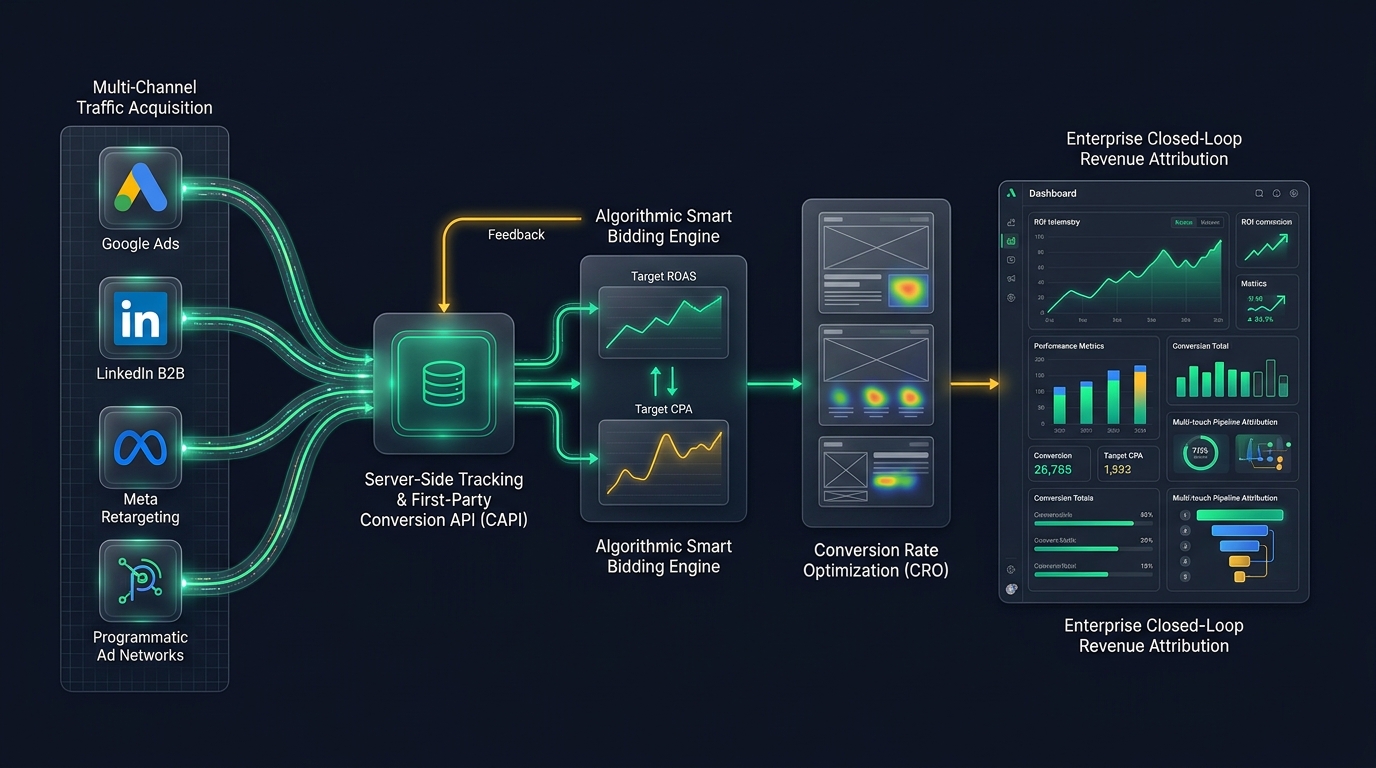
Google Partner PPC management across Google Ads, Meta, and YouTube with conversion tracking, search-term reviews, landing-page alignment, and reporting.
Ad Creative Variants & Channel-Specific Video Concepts
Audience Research & Lookalike Testing
Bid Strategy Review & Negative Keyword Management
Conversion, Lead-Quality, ROAS & CPA Reporting
How to Evaluate PPC Advertising
Paid media should connect search intent, creative, landing-page relevance, and measurement. We structure campaigns around the commercial questions people are already asking, then use search terms and conversion signals to improve decisions over time.
Capturing active buyer demand without wasting ad spend
Paid search works best when buyers are actively searching for a solution you can fulfill profitably today. It struggles when campaigns lump broad research queries together with commercial terms, rely on unmonitored automated matching, or send traffic to generic pages.
Tight campaign structure and weekly search-term pruning
Separate brand, competitor, solution, and remarketing intent.
Match ad promises to a useful landing-page next step.
Define qualified conversion events before optimization begins.
We organize campaigns by distinct buyer intent, maintain disciplined negative-keyword lists, write specific ad copy that pre-qualifies budget or geography, and feed verified CRM conversions back into bidding so algorithms optimize for real customers rather than spam form fills.
Auditable change logs and clean account structure
You keep full admin access to your Google, Bing, and Meta ad accounts alongside clear monthly reporting breaking down spend, cost per qualified lead, search-term quality, landing-page conversion rates, and planned tests.
Common PPC mistakes that inflate cost per acquisition
Leaving Performance Max or broad match running without brand exclusions, mixing high-intent service queries with informational queries, and failing to track phone or offline CRM closes routinely waste 25% to 40% of ad budgets.
How we launch and stabilize paid search accounts
Week 1 audits historical search terms, fixes broken conversion tags, and rebuilds tightly themed ad groups with starter negative lists. Weeks 2 through 4 run daily search-term checks, bid adjustments, and landing-page headline alignment to eliminate wasted spend quickly.
Account hygiene indicators reviewed every week
We inspect exact-match vs. broad-match search-term relevance, impression share lost to budget or rank, landing-page speed and message match, offline CRM conversion imports, and cost per qualified inquiry.
Focusing initial ad budgets on high-intent search demand
Early PPC campaigns perform best when concentrated on exact and phrase-match commercial queries backed by matched landing pages and tight negative keyword lists. Broad-match expansion, YouTube prospecting, and Performance Max asset scaling come in Phase 2 after clean conversion volume builds reliable bidding history.
Items to bring to a PPC account audit
Read access to existing Google Ads, Microsoft Ads, or Meta Ads accounts.
Monthly working media budget and target regions or zip codes.
Examples of recent qualified leads versus low-quality inquiries to exclude.
Landing page URLs and phone/form tracking tools currently in use.
Common questions about PPC management fees and spend
Do we pay ad spend to Blunt Soft LLC or directly to Google and Meta?
You pay Google and Meta directly on your own corporate card or invoice account. Our management fee stays completely separate and transparent with zero hidden media markups.
How often are search terms, bids, and ad copy reviewed?
Active accounts receive weekly search-term pruning to block wasted spend, biweekly creative and landing-page testing, and clear monthly P&L reviews tying cost per lead to sales outcomes.
Paid Search Management That Starts with Measurement and Margin
PPC management should connect a real offer to qualified demand and give the business enough evidence to decide where the next advertising dollar belongs. Clicks and platform-reported conversions are not the final objective. This guide explains how Blunt Soft LLC approaches Google Ads and paid media through conversion architecture, search intent, landing-page alignment, budget control, lead-quality feedback, transparent reporting, and client ownership of advertising assets.
Published by: Blunt Soft LLC · Reviewed: October 20, 2026 · Purpose: Paid-media economics, measurement, management, and account-ownership guidance
This service may be a good fit when
The offer, geography, customer, and commercial action can be defined clearly enough to build a focused test.
The business can track meaningful outcomes and share lead or revenue quality with the campaign team.
There is enough budget and operational capacity to learn without treating every click as an immediate success or failure.
Pause and clarify the brief when
The economics cannot support likely acquisition costs and no test budget has been approved.
The landing experience, fulfillment, sales follow-up, or conversion measurement cannot be changed.
The requirement is a guaranteed ROAS, cost per lead, or volume before the account has reliable data.
01
Define the economics before choosing campaigns
A paid-media plan begins with the action the business can afford to buy. For ecommerce, that may require contribution margin, repeat purchase behavior, returns, and fulfillment capacity. For lead generation, it requires an honest view of lead-to-opportunity and opportunity-to-sale rates, sales cycle, average value, and which inquiries the team can serve. Platform ROAS can look strong while the underlying orders are unprofitable or the leads never become qualified conversations.
Blunt Soft LLC uses those inputs to define a testable acquisition target and the uncertainty around it. If the data is incomplete, the initial campaign should be designed to learn rather than presented as a predictable revenue machine. Buyers should be cautious when an agency forecasts exact returns without access to margins, historical conversion quality, seasonality, geography, offer strength, or the capacity of the team that handles demand.
Revenue, contribution margin, or qualified-pipeline definition
Sales and fulfillment capacity included in budget decisions
A test objective that acknowledges uncertainty
02
Build conversion measurement before automated bidding
Google Ads optimization depends on the conversion actions supplied to the platform. Those actions need clear definitions. A purchase with value and transaction ID is different from a page view; a booked qualified consultation is different from a form submission; a phone call is useful only when the business can judge its outcome. Primary and secondary actions should reflect which signals are allowed to guide bidding and which are diagnostic.
Implementation can use the Google tag, Google Tag Manager, Google Analytics imports, platform APIs, call tracking, or offline conversion imports depending on the journey. The team should prevent duplicate events, validate dynamic values, test consent behavior, and document attribution limitations. Blunt Soft LLC treats measurement as a release with acceptance criteria, because bidding strategies trained on inflated or low-quality signals can spend efficiently against the wrong goal.
Primary conversions tied to meaningful business actions
Deduplication, transaction values, and consent-aware testing
Offline or CRM feedback where sales happen after the click
03
Structure paid search around intent and control
Campaign and ad-group structure should make budgets, geography, intent, landing pages, and reporting understandable. Brand searches, competitor terms, specific services, broader category research, remarketing, and experimental campaigns can behave very differently. Combining them without a reason makes it difficult to know what is driving performance or to protect budget for the highest-priority opportunities.
Account structure should be as simple as the buying journey allows. Excessive fragmentation can starve campaigns of data and create maintenance work; excessive consolidation can hide meaningful differences. Buyers should ask why campaigns are separated, how shared budgets are used, and which controls remain available when automation is introduced. The answer should connect structure to a commercial decision, not to a universal agency template.
Budget and reporting boundaries aligned with buyer intent
Enough consolidation to learn without hiding important differences
Clear reasons for brand, non-brand, competitor, and experiment separation
04
Use search terms and negative keywords as customer research
Keywords express the targeting hypothesis; search terms reveal what people actually typed. Review should identify qualified language, irrelevant meanings, research-stage questions, locations, jobs, support requests, and other traffic that does not fit the offer. Negative keywords protect budget, but overly broad exclusions can remove valuable demand. Match types, close variants, and automation require monitoring in the context of the account rather than a one-time list uploaded at launch.
Search-term findings should improve more than the ad account. They can reveal unclear positioning, missing landing-page information, new service language, and questions sales should answer. Blunt Soft LLC documents important exclusions and themes so decisions are reviewable. Buyers should expect the management cadence to change as new terms, products, competitors, and market conditions appear.
Regular search-term review linked to lead quality
Shared negative lists with documented exceptions
Insights returned to landing pages, sales, and offer strategy
05
Align ads and landing pages with the same promise
A person who clicks an ad should immediately recognize the offer, audience, and next step that the ad described. Google Ads guidance emphasizes alignment among keywords, ad copy, calls to action, and landing pages. That alignment also serves the visitor: it reduces the work required to confirm that they arrived in the right place. Sending every query to a generic homepage often weakens relevance and forces the visitor to restart the search.
A landing page should explain fit, provide enough proof, address material objections, and make the intended action accessible. Fast loading, mobile usability, clear form labels, privacy context, and honest expectations matter. Testing can compare meaningful hypotheses in the headline, proof, offer, form, or layout, but teams should avoid declaring a winner from tiny samples or changing several variables without being able to interpret the result.
Message continuity from query to ad to landing page
Relevant proof, qualification, and a specific next action
Accessible, mobile-friendly forms and responsible experiments
06
Choose bidding and budgets based on signal quality
Automated bidding can use large amounts of auction-time information, but it cannot repair a weak offer or decide which business outcomes genuinely matter. Target CPA, target ROAS, maximize conversions, maximize conversion value, and manual controls each have conditions and tradeoffs. The appropriate approach depends on conversion volume, value accuracy, campaign maturity, budget flexibility, and the cost of learning.
Budgets need enough room to test while respecting commercial limits. Frequent large changes can make results difficult to interpret, while a budget that cannot generate meaningful data may produce false certainty. Blunt Soft LLC documents major bidding and budget changes with the hypothesis behind them. Buyers should ask how long an experiment will run, what would cause it to stop, and which metric determines whether additional spend is justified.
Bidding strategy matched to volume and trustworthy values
Budget changes connected to a written hypothesis
Guardrails for learning cost, downside, and stopping decisions
07
Close the loop between leads, sales, and advertising
Lead-generation accounts often optimize toward the easiest form fill rather than the most valuable opportunity. The solution is a feedback loop. Sales or intake teams need consistent qualification reasons, and advertising teams need privacy-appropriate outcome data at a cadence that can influence targeting and bidding. Offline conversion imports or enhanced lead workflows may help when configured correctly, but a simple shared quality review is still better than treating every inquiry as equal.
The feedback loop can reveal geographic mismatch, consumer inquiries in a B2B campaign, support requests, low-budget prospects, duplicate leads, or a slow response process. Not every problem belongs to media buying. Blunt Soft LLC separates traffic quality from landing-page, offer, and follow-up issues so the team can address the actual constraint rather than repeatedly changing keywords.
Consistent lead-status and disqualification definitions
Privacy-aware offline outcome feedback
Shared responsibility across campaigns, landing pages, and sales follow-up
08
Use Performance Max and paid social with clear roles
Cross-network and algorithmic campaign types can extend reach, but they require strong inputs: accurate conversion goals, usable creative, clean product or audience data, sensible exclusions, and a clear relationship to other campaigns. Performance Max should not become a place to hide brand demand or poor reporting. Buyers should understand what the campaign is meant to add, what controls are available, and how incremental value will be assessed.
Paid social usually reaches people before they express the same explicit intent seen in search. Creative therefore carries more of the targeting and qualification work. The campaign needs a repeatable process for concepts, formats, approvals, fatigue monitoring, and landing-page continuity. Blunt Soft LLC treats Google, Meta, LinkedIn, YouTube, or other channels as different environments with different buyer behavior, not interchangeable places to publish the same asset.
A defined role for each network and campaign type
Accurate feeds, audiences, creative, goals, and exclusions
Incrementality questions separated from platform attribution
09
Run experiments that can change a decision
An experiment is useful when the result will change a budget, message, audience, landing page, or offer decision. The team should state the hypothesis, primary measure, guardrails, duration or evidence threshold, and what happens after each outcome. Tests should account for seasonality, promotion changes, sales capacity, and other events that can distort interpretation. Platform recommendations are inputs to review, not automatic instructions.
Creative and copy testing should explore meaningful differences rather than endless punctuation changes. Landing-page work may address relevance, proof, friction, qualification, or the call to action. Search tests may examine match strategy, geography, bid approach, or a distinct offer. Buyers should receive an experiment record that preserves what was learned so a future manager does not repeat old tests without context.
A decision-changing hypothesis and primary measure
Guardrails for cost, quality, and user experience
A learning record that survives team or agency changes
10
Demand transparent reporting and account ownership
The client should normally own the advertising account, analytics properties, tag-management container, audiences, and landing-page assets, with the agency receiving appropriate access. This preserves history and reduces dependency if the relationship changes. Billing, admin roles, conversion definitions, and third-party tracking costs should be visible. A live dashboard is helpful, but it does not replace an explanation of decisions and next actions.
Management pricing may be fixed, tiered, based on scope or spend, or combine setup and ongoing work. Buyers should examine incentives: a percentage of spend can be simple, but it should not reward spending more without regard to quality. The agreement should specify channels, campaign count or complexity, creative responsibility, landing-page work, tracking, meeting cadence, reporting, and termination access. Blunt Soft LLC does not guarantee ROAS or lead volume because auctions, competitors, offers, conversion rates, and market demand remain outside any agency's control.
Client ownership with role-based agency access
Definitions and decisions alongside performance numbers
Fees, scope, incentives, and exit access stated in writing
Buyer questions answered
How much ad spend is needed to start PPC?
There is no universal minimum. The useful budget depends on likely click costs, conversion rate, sales value, geography, competition, and how much evidence is needed for a decision. A focused test with clear guardrails is more responsible than selecting a budget from a generic industry rule.
How quickly can PPC generate results?
Campaigns can generate traffic as soon as they are eligible, but reliable conclusions take longer. Tracking validation, auction volume, sales-cycle length, conversion quality, and testing all affect timing. Early activity should be treated as evidence to interpret, not proof of stable future returns.
Can Blunt Soft LLC guarantee ROAS or cost per lead?
No. Auctions, competitor behavior, market demand, offer strength, landing-page conversion, sales follow-up, and platform changes are not fully controlled by an agency. We can define targets, implement measurement, manage campaigns, and report decisions transparently without inventing guarantees.
Who owns the Google Ads account and campaign data?
The client should own the account and grant role-appropriate access to Blunt Soft LLC. The agreement should also cover analytics, tag management, creative, landing pages, feeds, and third-party tools. Ownership and exit access are confirmed before work begins.
What should be audited before a PPC relaunch?
Review conversion actions, tag duplication, account access, billing, search terms, negatives, geography, schedules, audiences, ad-policy issues, landing-page relevance, lead quality, historical experiments, and downstream sales outcomes. Fixing measurement often comes before changing bids or budgets.
What should happen before a PPC campaign is scaled?
Before spend increases, the account needs reliable conversion tracking, clear offer pages, search-term review, and a definition of what qualifies as a useful lead or sale.
What is included in the PPC Advertising project delivery?
All deliverables include custom architecture, complete Git repository source code access, automated testing, deployment staging, and 100% intellectual property ownership backed by our Delaware bilateral NDA.
What are the typical delivery timelines for PPC Advertising?
Estimated delivery timelines range from 4 to 30 business days depending on the selected package tier and statement of work.
How does Blunt Soft assure quality and post-launch support?
Every deliverable is verified through strict functional testing, security checks, and includes a 30-day post-launch bug warranty with defect remediation.